How Fixture Congestion Affects Football Performance: Fatigue, Rotation and Recovery Explained
01
Nov
2026
How Fixture Congestion Affects Football Performance: Fatigue, Rotation and Recovery Explained
Modern professional football places enormous physical and mental demands on players. Between domestic league matches, national cup competitions, international tournaments, and European fixtures, elite teams can face several competitive matches within a short period.
This demanding schedule introduces one of the most important factors in modern football performance analysis: fixture congestion.
Fixture congestion occurs when teams play multiple matches with relatively limited recovery time between them. It can influence player availability, physical performance, tactical decisions, squad rotation, and the way teams approach different competitions.
Understanding fixture congestion is essential for anyone interested in football performance, match previews, sports science, or tactical analysis.
At LincBet, examining the wider context surrounding a football match helps readers interpret team performance beyond simple league standings and recent results.
In this guide, we explain how fixture congestion affects football teams, why rest days matter, how managers organize squad rotation, and which indicators can help analysts recognize scheduling-related performance challenges.
⚽ 1. What Is Fixture Congestion in Football?
Fixture congestion refers to a period when a football team faces a high concentration of matches within a relatively short timeframe.
For example, a club may play:
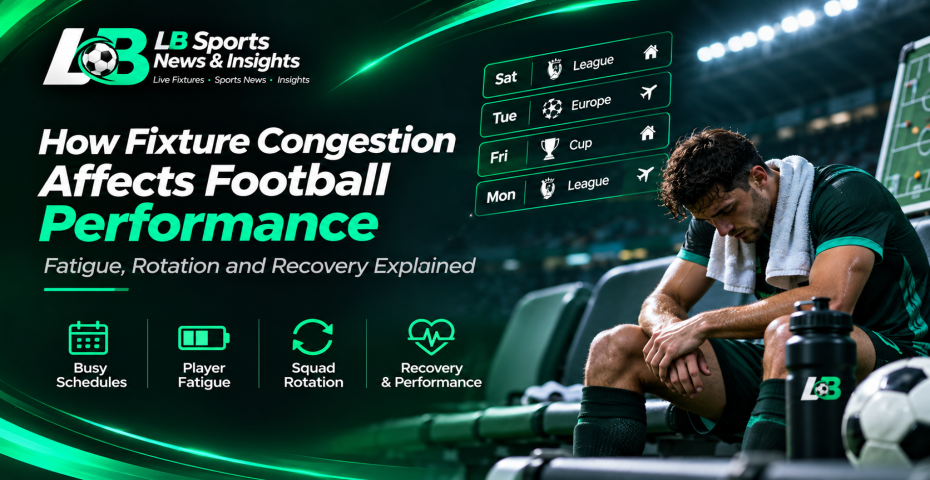
A domestic league match on Saturday.
A European competition fixture on Tuesday.
Another domestic league match on Friday.
A national cup match the following Monday.
This schedule requires players to repeatedly prepare, compete, recover, and travel with limited time between fixtures.
Example of a Congested Football Schedule
| Match | Competition | Day | Rest Before Match |
|---|---|---|---|
| Match 1 | Domestic League | Saturday | — |
| Match 2 | European Competition | Tuesday | 3 days |
| Match 3 | Domestic League | Friday | 3 days |
| Match 4 | National Cup | Monday | 3 days |
This schedule is hypothetical and illustrates the time between kickoff dates.
Although three calendar days separate successive matches, the actual recovery window depends on kickoff times, travel, training requirements, and individual player circumstances.
Fixture congestion does not necessarily cause poor performance. However, it can increase the difficulty of maintaining consistent physical preparation and managing squad availability.
🏃 2. How Football Matches Affect Physical Recovery
Professional football requires repeated accelerations, decelerations, changes of direction, jumping, tackling, and high-speed running.
These movements create physical demands extending beyond the final whistle.
Recovery may involve several interacting processes:
Restoration of energy stores
Repair of exercise-related muscle damage
Reduction of temporary muscle soreness
Rehydration
Sleep and psychological recovery
Management of accumulated training and match loads
The time required for recovery varies between players and match circumstances.
For example, a central midfielder involved in frequent high-intensity transitions may experience a different physical workload from a player operating in a less physically demanding role during the same match.
Recovery should therefore be evaluated individually rather than assuming every player responds identically to a congested schedule.
⏱️ 3. Why Rest Days Matter in Football
Rest days are an important part of football performance management.
The period between matches allows coaches and medical staff to balance recovery, tactical preparation, and physical training.
Teams facing longer recovery periods may have more opportunities to organize training sessions and prepare for upcoming opponents.
Teams facing shorter recovery periods often need to prioritize rehabilitation, lower-intensity preparation, and tactical meetings.
Comparing Different Recovery Windows
| Time Between Matches | Potential Management Priority |
|---|---|
| 2 days | Recovery and limited preparation |
| 3 days | Recovery with selective tactical work |
| 4 days | Greater flexibility for training |
| 5–6 days | More extensive preparation opportunities |
| 7+ days | Broader training and recovery planning |
These are illustrative planning scenarios, not universally established safe or unsafe recovery thresholds.
The effect of a particular rest interval depends on match intensity, playing time, travel, injury status, and the player's physical condition.
Does More Rest Always Mean Better Performance?
Not necessarily.
Additional rest can create recovery opportunities, but match rhythm, training quality, player readiness, and tactical preparation also matter.
A well-managed team playing frequently may maintain stronger performances than a poorly prepared team with a longer break.
The key is understanding the relationship between scheduling, recovery, and overall preparation.
🛡️ 4. Fixture Congestion and Injury Considerations
One of the major concerns surrounding demanding football schedules is player health.
Frequent matches can create challenges in managing physical workloads, particularly when players repeatedly accumulate substantial minutes.
However, injury risk is influenced by many factors, including:
Previous injuries
Individual physical condition
Match exposure
Training loads
Recovery opportunities
Age and playing history
Match intensity
Medical management
Fixture congestion should not be treated as the sole explanation for an injury.
Injury patterns differ between teams and competitions, and scientific findings depend on the definition of congestion and the outcomes measured.
Why Squad Depth Matters
A team with several suitable replacements may distribute playing time more effectively.
A team relying heavily on a small core of players may have fewer options when several fixtures arrive close together.
This makes squad depth an important consideration when evaluating teams participating in multiple competitions.
🔄 5. Understanding Squad Rotation
Squad rotation occurs when a manager changes the starting lineup or distributes minutes across available players.
Rotation can serve several purposes:
Managing accumulated playing time.
Preparing players for upcoming fixtures.
Responding to injuries or suspensions.
Adapting tactics to different opponents.
Providing opportunities to squad players.
Maintaining competitive performance across tournaments.
Illustrative Rotation Strategy
| Player Group | Previous Match | Upcoming Match | Possible Decision |
|---|---|---|---|
| Regular Starters | 90 minutes | League fixture | Assess recovery |
| Rotation Players | 20 minutes | League fixture | Consider starting |
| Recently Injured Players | Limited minutes | League fixture | Follow medical guidance |
| Young Squad Players | Unused | Cup fixture | Consider involvement |
These decisions depend on actual player availability and the coaching staff's judgment.
A rotated lineup is not automatically weaker.
Some clubs have sufficient depth to maintain performance with multiple personnel changes.
Other teams experience more significant differences between their preferred starting eleven and available substitutes.
🧠 6. How Fixture Congestion Can Influence Tactics
Football tactics may change when teams face compressed schedules.
Managers need to consider both the immediate opponent and the physical demands of upcoming fixtures.
Potential adjustments include:
More selective pressing
Reduced emphasis on continuous high-intensity transitions
Increased use of possession to manage game tempo
Changes in defensive positioning
Earlier substitutions
Different player combinations
Example: High Pressing vs Compact Defending
A high-pressing team frequently attempts to regain possession quickly through coordinated pressure.
This approach can involve repeated accelerations, rapid positional adjustments, and considerable physical demands.
A compact defensive approach may involve different movement patterns and a lower defensive block.
However, no tactical system guarantees lower overall fatigue.
A team defending deeply may spend long periods without possession and face sustained defensive pressure.
Therefore, tactical changes should be analyzed through actual match activity rather than simplistic assumptions about formations.
✈️ 7. Travel Distance and Its Impact on Football Preparation
Travel is another important component of demanding football schedules.
Clubs competing internationally may experience:
Long flights
Time-zone changes
Different climatic conditions
Disrupted sleep routines
Changes in meal schedules
Limited preparation time
Domestic vs International Travel
| Travel Factor | Domestic Fixture | International Fixture |
|---|---|---|
| Travel Distance | Often shorter | Can be substantially longer |
| Time-Zone Changes | Usually limited | Sometimes significant |
| Sleep Disruption | Possible | Potentially greater |
| Recovery Planning | Depends on itinerary | May require additional planning |
| Match Preparation | Schedule-dependent | Schedule-dependent |
This comparison is general; some domestic journeys are longer than international journeys.
Why Travel Context Matters
Two teams may have the same number of rest days but different travel demands.
For example, one may remain at home for successive fixtures while another travels across several countries.
Understanding the complete schedule can provide a more useful picture than counting rest days alone.
📊 8. Which Statistics Help Identify Scheduling Effects?
Fixture congestion is not directly represented by a single football performance statistic.
Instead, analysts can examine multiple indicators.
| Indicator | Analytical Purpose |
|---|---|
| Rest Days | Time available between fixtures |
| Minutes Played | Individual match exposure |
| Starting Lineup Changes | Degree of squad rotation |
| High-Speed Running | Physical activity patterns, when available |
| Sprint Frequency | Repeated high-intensity activity |
| Goals Conceded | Defensive results |
| Expected Goals Against | Quality of chances conceded |
| Shots Created | Attacking activity |
| Substitution Timing | Squad and workload decisions |
These indicators should be compared across appropriate periods and adjusted for relevant match circumstances.
For example, a decline in total shots may result from stronger opponents or different tactics rather than fatigue.
Similarly, an increase in goals conceded does not automatically indicate insufficient recovery.
Statistical analysis becomes useful when several indicators reveal a consistent pattern.
🏆 9. Why Teams Playing Multiple Competitions Need Special Attention
Clubs competing in domestic leagues, national cups, and international tournaments face additional scheduling complexity.
Consider a hypothetical team participating in three competitions:
| Competition | Primary Scheduling Challenge |
|---|---|
| Domestic League | Regular weekly commitments |
| National Cup | Additional knockout fixtures |
| International Tournament | Midweek matches and travel |
The manager must allocate resources across multiple objectives.
Some teams prioritize particular competitions according to sporting ambitions and squad circumstances.
Others attempt to maintain maximum competitiveness in every tournament.
Analysts should examine the club's recent lineup decisions and statements rather than assuming a manager will automatically rotate before or after a major fixture.
📅 10. How to Analyze a Team's Next Five Fixtures
A practical way to evaluate congestion is to examine the upcoming fixture calendar.
Hypothetical Five-Match Schedule
| Date | Fixture | Location | Competition |
|---|---|---|---|
| November 3 | Team A vs Team B | Home | League |
| November 6 | Team C vs Team A | Away | European |
| November 9 | Team A vs Team D | Home | League |
| November 13 | Team E vs Team A | Away | Cup |
| November 17 | Team A vs Team F | Home | League |
All teams and fixtures in this example are fictional.
A useful analysis would consider:
First: How many calendar days separate the fixtures?
Second: Which matches require substantial travel?
Third: Which players have accumulated significant minutes?
Fourth: Are important starters returning from injury?
Fifth: Does the club have sufficient replacements for demanding positions?
Sixth: Are there differences in opponent quality and tactical requirements?
This approach can reveal scheduling challenges that are not visible in league standings.
📉 11. Does Fixture Congestion Affect Match Results?
Fixture congestion can influence match preparation, player availability, and physical demands.
However, its impact on results is not uniform.
Some teams maintain strong performances despite demanding schedules.
Others struggle when injuries, limited squad depth, or travel demands accumulate.
An effective evaluation must distinguish correlation from causation.
Suppose a team loses three consecutive matches during a congested period.
The results alone do not prove that scheduling caused the defeats.
Other explanations may include:
Stronger opponents
Poor finishing
Defensive mistakes
Tactical mismatches
Injuries unrelated to congestion
Natural variation in match outcomes
A structured analysis evaluates these competing explanations before reaching a conclusion.
🎯 12. Fixture Congestion and Football Match Predictions
Schedule analysis can provide useful context when evaluating upcoming football fixtures.
A match preview may examine:
Previous kickoff dates
Travel requirements
Recent team selections
Important absences
Player minutes
Upcoming competition commitments
Possible tactical adjustments
Example Match Analysis
Imagine two hypothetical teams preparing for a league match.
| Factor | Home Team | Away Team |
|---|---|---|
| Days Since Last Match | 6 | 3 |
| Previous Match Location | Home | Away |
| Recent International Travel | None | Yes |
| Major Squad Rotation | Limited | Significant |
| Key Players Available | Mostly available | One doubtful |
The home team appears to have a more favorable recovery schedule.
However, the away team's rotation may mean that several starters remain relatively fresh.
The analyst should therefore avoid concluding that the home team has a decisive advantage based on rest days alone.
Instead, scheduling information becomes one component of a broader evaluation that includes form, opponent quality, tactics, and team news.
🧬 13. Modern Sports Science and Player Load Management
Professional football clubs increasingly use sports-science methods to monitor player readiness and performance.
Depending on their resources, clubs may assess:
Training duration and intensity
Match minutes
Running distances
Acceleration and deceleration patterns
Player-reported fatigue
Sleep quality
Recovery indicators
Medical assessments
These measurements support individual decision-making.
What Is Player Load Management?
Player load management involves monitoring and adjusting physical demands across training and competition.
The goal is to support performance and player availability while accounting for individual circumstances.
There is no single universal workload number that guarantees safety.
Individual readiness cannot be determined accurately from publicly available match minutes alone.
This distinction matters when interpreting reports about fatigue and possible lineup changes.
📱 14. How LincBet Readers Can Use Fixture Information
Football followers can benefit from considering match scheduling alongside traditional performance statistics.
LincBet provides football-related resources covering match information, predictions, sports news, and educational topics.
Live Matches
Following upcoming fixtures helps readers understand when teams are scheduled to compete and identify potentially demanding periods.
Betting Tips and Match Previews
Pre-match analysis can combine available performance information with contextual factors such as recent scheduling, injuries, and squad selection.
Sports News
Team updates and confirmed announcements may provide additional information about player availability and managerial decisions.
Educational Resources
Articles explaining football performance and statistical interpretation help readers understand why past results do not always capture the complete context of an upcoming match.
By considering schedule intensity, squad rotation, and recovery requirements, readers can develop a more complete view of football performance.
❓ 15. Frequently Asked Questions About Fixture Congestion
What does fixture congestion mean in football?
Fixture congestion describes a period when a team plays several matches with relatively short intervals between them.
Can football players recover fully in three days?
Recovery requirements vary between individuals and circumstances. A three-day interval does not guarantee complete recovery or automatically indicate insufficient recovery.
Does fixture congestion increase injury risk?
Congested schedules can create workload-management challenges, but injury risk depends on several factors. Research findings vary according to the injury type, exposure, and definition of congestion.
Why do managers rotate players?
Managers rotate players to manage playing time, respond to tactical needs, address availability, and prepare for multiple competitions.
Is a team with more rest days always favored?
No. Rest can be helpful, but team quality, tactics, player selection, and opponent strength also influence performance.
Does international travel affect football performance?
Travel can affect preparation, sleep, and recovery opportunities, especially when journeys involve long distances or time-zone changes.
How can fans identify fixture congestion?
They can examine a club's recent and upcoming matches, compare rest intervals, review travel demands, and monitor squad rotation.
Do busy schedules always reduce goals scored?
No. Attacking output depends on many variables, including opponent strength, tactical choices, and player availability.
Which football teams are most affected by congested schedules?
The effects depend on squad resources, travel, match intensity, player workload, and other contextual factors rather than the team's reputation alone.
Why is fixture congestion important for match analysis?
It provides information about preparation conditions, player recovery, potential rotation, and tactical decisions that may not be apparent from historical results.
✅ 16. Final Thoughts: Why Scheduling Is an Essential Part of Football Analysis
Football performance is influenced by more than technical ability, squad value, or league position.
Match schedules create practical challenges involving recovery, preparation, travel, and player availability.
Fixture congestion can influence how managers select their teams, adjust tactics, and distribute physical workloads.
However, it does not produce predictable effects in every match.
Some teams maintain consistent results through effective rotation and squad depth.
Others may experience difficulties when demanding schedules coincide with injuries or limited personnel.
The most useful analytical approach combines fixture information with current team news, performance statistics, tactical context, and opponent quality.
At LincBet, understanding these factors adds another dimension to football education and helps readers develop a more informed perspective on match preparation and performance.
Great football analysis is not only about how teams play — it is also about the conditions under which they compete.